
What Is Anorectal Dyssynergia?
Anorectal dyssynergia is a functional bowel disorder in which the muscles of the rectum and anal sphincter do not coordinate properly during a bowel movement. Normally, the pelvic floor muscles relax while the rectum contracts to push stool out; in anorectal dyssynergia, the pelvic floor muscles contract instead of relaxing, or the rectum fails to generate enough pushing force, so stool cannot be expelled effectively even when it has reached the rectum. Because this is a coordination problem rather than a structural blockage, most patients improve substantially once the specific pattern is identified and retrained through targeted therapy, which is why persistent straining should not be managed with escalating laxative doses alone, and why some patients specifically look for dyssynergic defecation treatment in Delhi rather than continuing self-medication.
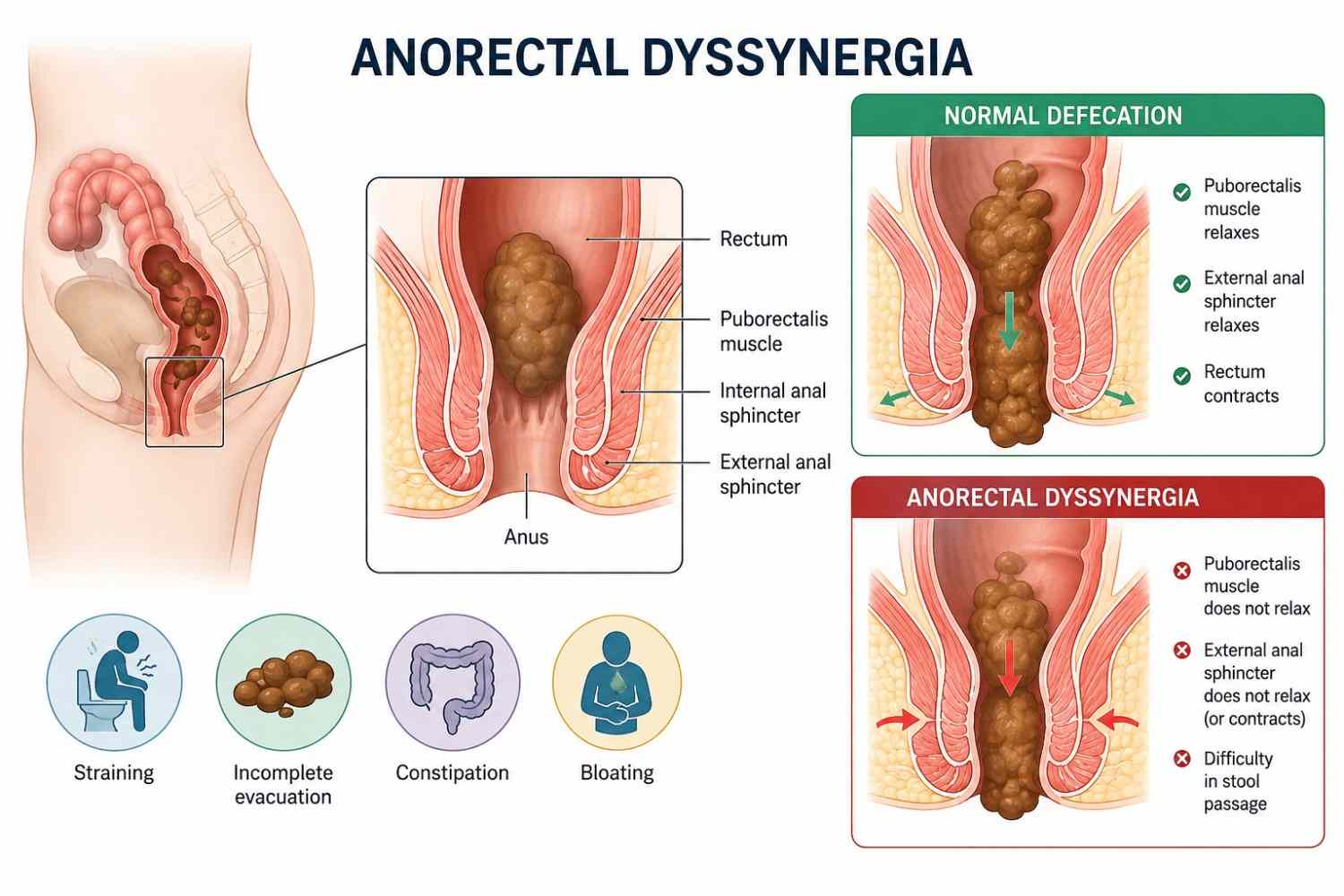
Common Symptoms of Anorectal Dyssynergia
People experiencing anorectal dyssynergia typically report one or more of the following:
Chronic Constipation
Chronic constipation that does not improve with dietary or lifestyle changes alone.
Excessive Straining
Excessive straining during bowel movements.
Incomplete Bowel Evacuation
A persistent feeling of incomplete bowel evacuation.
Impaired Muscle Coordination
Difficulty coordinating the muscles needed to pass stool, despite normal urge.
Hard or Infrequent Stools
Hard, lumpy, or infrequent stools.
Manual Assistance
Needing manual assistance (such as pressing on the abdomen or vaginal wall) to help pass stool.
Abdominal Discomfort
Abdominal discomfort, pressure, or bloating linked to retained stool.
Prolonged Toilet Time
Spending unusually long periods on the toilet without adequate relief.
Subtypes of Anorectal Dyssynergia
Anorectal dyssynergia is broadly grouped by the specific coordination pattern involved: in one common pattern, the pelvic floor and anal sphincter muscles contract paradoxically instead of relaxing during straining, while in another, the rectum simply fails to generate enough propulsive force to push stool out even when the pelvic floor relaxes appropriately. Some patients show a mix of both patterns. Pelvic floor dyssynergia treatment in Delhi is tailored to the specific pattern identified on testing, since a treatment plan built around retraining muscle relaxation works differently from one built around improving rectal propulsive effort — which is one reason the exact pattern is confirmed on anorectal manometry rather than assumed from symptoms alone.
What Causes Anorectal Dyssynergia?
Anorectal dyssynergia develops when the coordination between the pelvic floor muscles and the anal sphincter breaks down, and several factors can contribute:
- Pelvic floor muscle dysfunction or poor awareness of pelvic floor movement
- A learned habit of tightening rather than relaxing the pelvic floor, often dating back to childhood or a period of painful defecation
- Long-standing chronic constipation and anorectal dyssynergia reinforcing each other over time
- Nerve or sensory changes affecting rectal awareness of stool
- Long-term straining during bowel movements
- Underlying behavioural or functional bowel disorders
- Pregnancy, childbirth, or pelvic surgery affecting pelvic floor coordination
Anorectal Dyssynergia Treatment in Delhi
Anorectal dyssynergia treatment in Delhi begins with confirming the specific muscle-coordination pattern on testing, since treatment differs depending on whether the main problem is paradoxical contraction, inadequate propulsion, or a mix of both. Chronic constipation and anorectal dyssynergia treatment in Delhi typically means a structured course of biofeedback therapy to retrain the pelvic floor, combined with dietary and lifestyle changes to support regular bowel habits.
For most patients, this means starting with confirmatory testing and a defined course of biofeedback sessions, and monitoring response with a follow-up review rather than relying on increasing doses of laxatives if symptoms do not fully settle.
How Anorectal Dyssynergia Is Diagnosed
Doctors may use a combination of the following to confirm anorectal dyssynergia and identify its pattern:
-
Anorectal Manometry
A thin catheter measures the pressure and coordination of the rectal and anal muscles during rest, squeeze, and attempted straining, directly confirming whether the muscles relax or contract paradoxically.
-
Balloon Expulsion Test
A small balloon is placed in the rectum and the patient is asked to expel it; difficulty or prolonged time to expel the balloon supports a diagnosis of pelvic floor dyssynergia.
-
Defecography
This imaging test evaluates the process of defecation in real time and helps identify abnormalities in rectal emptying and pelvic floor movement.
-
Colonoscopy
Performed to rule out structural problems, strictures, or other conditions affecting the colon and rectum before attributing symptoms to dyssynergia alone.
-
Pelvic Floor Physical Examination
A focused examination to assess the coordination, strength, and relaxation of the pelvic floor muscles during simulated straining.
Anorectal Dyssynergia Treatment in South Delhi
For residents of South Delhi, having anorectal dyssynergia treatment in South Delhi available close to home matters because confirming a diagnosis, starting biofeedback therapy, and reviewing progress usually takes several visits rather than one. Initial evaluation, anorectal manometry, and a structured course of retraining sessions is a process that is far more manageable when the clinic is not a long drive away.
Patients searching for an anorectal dyssynergia specialist in Delhi are usually looking for the same combination of things: a clear explanation of which coordination pattern is responsible, prompt access to manometry or balloon expulsion testing, and a treatment plan that goes beyond repeated laxative use.
Delhi Gastro Care is based at Fortis Escorts Hospital, Okhla Road, and is accessible to patients across South Delhi neighbourhoods such as Greater Kailash, Saket, Vasant Kunj, Lajpat Nagar, and Nehru Place. Whether you are looking for an anorectal dyssynergia specialist in South Delhi for a first opinion or a gastroenterologist for anorectal dyssynergia in Delhi to review constipation that keeps returning, having testing and biofeedback therapy under one roof simplifies the process considerably.
Treatment Options for Anorectal Dyssynergia
Treatment focuses on retraining the pelvic floor muscles to coordinate correctly, easing straining, and restoring regular, complete bowel movements.
Biofeedback Therapy
Biofeedback therapy for anorectal dyssynergia in Delhi uses real-time sensor feedback to help patients learn to relax the pelvic floor and coordinate pushing effort correctly; this is the most evidence-backed treatment for the condition and is typically delivered over several sessions.
Pelvic Floor Physical Therapy
Hands-on physical therapy techniques complement biofeedback by improving pelvic floor muscle awareness, flexibility, and coordination outside of formal sessions.
Dietary Changes with Increased Fibre Intake
Adjusting fibre and fluid intake supports softer, easier-to-pass stool while the underlying coordination problem is being retrained.
Medications to Relieve Constipation
Stool softeners or osmotic laxatives may be used short-term to ease symptoms while biofeedback therapy takes effect, though medication alone rarely resolves the coordination problem.
Lifestyle Modifications
Regular toilet habits, correct toilet posture, and avoiding excessive straining help reinforce the gains made through biofeedback and physical therapy.
Choosing an Anorectal Dyssynergia Specialist in Delhi
Because anorectal dyssynergia can have more than one underlying pattern and often does not respond to diet or laxatives alone, choosing an anorectal dyssynergia specialist in Delhi who confirms the diagnosis with proper testing before starting treatment makes a meaningful difference to outcomes. The best gastroenterologist for anorectal dyssynergia in Delhi will look beyond a standard laxative prescription and assess pelvic floor coordination directly before finalising a treatment plan.
A few things worth checking before your first visit:
- Verified medical qualification and registration in gastroenterology
- On-site or nearby access to anorectal manometry and biofeedback therapy
- A clear explanation of which coordination pattern is responsible for your symptoms
- Experience managing chronic constipation, pelvic floor dysfunction, and dyssynergic defecation
- A treatment plan that combines biofeedback with practical lifestyle guidance and a follow-up review
At Delhi Gastro Care, Dr. (Brig) Pankaj Puri — a gastroenterologist for anorectal dyssynergia in Delhi practising at Fortis Escorts, Okhla — holds DM Gastroenterology training from PGIMER, Chandigarh, and FRCP qualifications from Edinburgh and London. He is the Director of Gastroenterology and Hepatology at the Fortis Escorts Liver and Digestive Diseases Institute and a Governing Council member of the Indian National Association for Study of the Liver. Diagnostic facilities relevant to anorectal dyssynergia, including anorectal manometry and biofeedback therapy, are available on-site.
Frequently Asked Questions
Find answers to common questions about anorectal dyssynergia, including its symptoms, causes, diagnosis, and treatment options.
Anorectal dyssynergia is a condition where the pelvic floor muscles and anal sphincter do not coordinate properly during a bowel movement, so the muscles contract instead of relaxing and make it difficult to pass stool even when it has reached the rectum.
Common symptoms include chronic constipation, excessive straining, a persistent feeling of incomplete evacuation, hard or infrequent stools, and sometimes needing manual assistance to pass stool.
Anorectal dyssynergia can be caused by pelvic floor muscle dysfunction, a learned pattern of tightening rather than relaxing during straining, nerve or sensory changes affecting rectal awareness, and long-term straining or chronic constipation.
Not exactly. Some patients show paradoxical contraction of the pelvic floor during straining, others have inadequate rectal propulsive force, and some show a mix of both. The exact pattern is confirmed on anorectal manometry and guides the treatment approach.
Treatment usually centres on biofeedback therapy to retrain pelvic floor coordination, supported by pelvic floor physical therapy, dietary changes with increased fibre, short-term medication for symptom relief, and lifestyle modifications such as correct toilet posture.
See a gastroenterologist if chronic constipation does not improve with dietary changes and standard laxatives, if you have a persistent feeling of incomplete evacuation, or if you regularly need manual assistance to pass stool.
Yes. Anorectal dyssynergia is a coordination disorder rather than a structural blockage, so most patients improve significantly with biofeedback therapy and pelvic floor retraining rather than surgery.
Look for a gastroenterologist with verified credentials, on-site or nearby access to anorectal manometry and biofeedback therapy, and a track record of confirming the specific coordination pattern before starting treatment rather than treating constipation generically.