A gastroenterologist recommending a test called “EUS” to investigate a pancreatic cyst, unexplained abdominal pain, or an abnormality found on an earlier scan is often the first time most patients hear the term. EUS in Delhi is used specifically because standard imaging sometimes cannot get close enough to organs like the pancreas and bile ducts to give a clear answer — and EUS solves that by placing the ultrasound probe on an endoscope, right next to the organ being examined, from inside the digestive tract.
This page explains what Endoscopic Ultrasound in Delhi involves, which conditions it is used to diagnose, how the procedure and preparation work, and what to expect if EUS-guided FNA biopsy is needed in the same sitting.
What Is Endoscopic Ultrasound (EUS)?
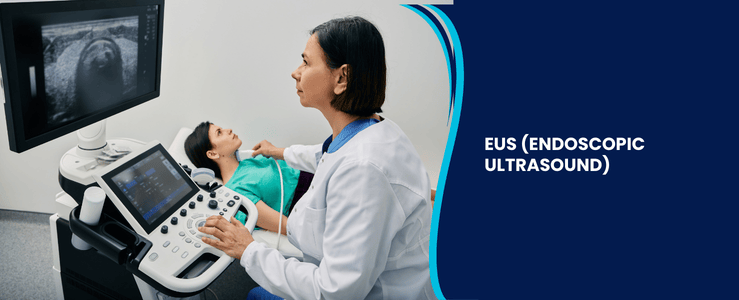
Endoscopic Ultrasound (EUS) is a diagnostic procedure that combines endoscopy with ultrasound technology to produce detailed images of the digestive tract and the organs surrounding it. A thin, flexible endoscope fitted with a small ultrasound probe is passed through the mouth into the digestive tract, allowing doctors to examine the esophagus, stomach, pancreas, liver, bile ducts, and nearby lymph nodes at close range. Because the ultrasound probe sits directly against or very close to these organs, EUS produces higher-resolution images of the pancreas and bile ducts than external abdominal ultrasound or standard CT scanning typically can.
Conditions Diagnosed with EUS
EUS in Delhi is most often used to investigate the following conditions with a level of detail that other imaging cannot always match:
Pancreatic Tumours and Cysts
EUS for pancreatic cancer in Delhi is one of the most precise ways to visualise the pancreas, helping detect tumours, cysts, or abnormal growths at an early stage, and to assess how far a tumour has spread before treatment planning.
Pancreatic Cysts
Pancreatic cyst diagnosis in Delhi frequently relies on EUS to characterise a cyst found incidentally on a CT or MRI scan, since EUS can assess its structure closely and, if needed, sample fluid from within it.
Esophageal and Stomach Cancer
EUS helps assess how deeply a tumour in the esophagus or stomach has spread into the surrounding tissue layers, which is important information for staging and treatment planning.
Gallstones and Bile Duct Problems
EUS for bile duct stones in Delhi can detect small gallstones and identify blockages or abnormalities in the bile ducts that may not be clearly visible on standard ultrasound.
Chronic Pancreatitis
Chronic pancreatitis diagnosis in Delhi is another common reason for EUS, since it is highly sensitive at identifying the long-term inflammation and structural changes in the pancreas that other scans can miss in earlier stages.
Submucosal Tumours and Lymph Node Enlargement
EUS can identify tumours growing beneath the lining of the digestive tract, which endoscopy alone may miss, and can evaluate enlarged lymph nodes to help distinguish infection from cancer.
Why EUS Is Performed
Endoscopic Ultrasound (EUS) is a specialized diagnostic procedure that combines endoscopy and ultrasound technology to obtain detailed images of the digestive tract and surrounding organs. Doctors typically recommend EUS in Delhi for one or more of the following reasons:
- Detecting tumours or abnormal growths
- Evaluating pancreatic diseases in detail
- Assessing and staging gastrointestinal cancers
- Examining the bile ducts and gallbladder
- Investigating unexplained abdominal pain
- Obtaining tissue samples via EUS-guided FNA biopsy
- Detecting cysts or lymph node enlargement
What Happens During the EUS Procedure
An EUS procedure in Delhi is minimally invasive and is usually completed in a single outpatient visit:
- Sedation is given to keep the patient comfortable throughout the procedure
- A flexible endoscope fitted with an ultrasound probe is passed through the mouth
- The doctor examines the digestive organs and surrounding structures in detail
- Ultrasound images are generated in real time for close evaluation
- A fine needle aspiration (FNA) biopsy may be performed during the same procedure if a suspicious area is found
- The procedure usually takes 30 to 60 minutes, depending on what is being evaluated
EUS-Guided FNA Biopsy
One of the most valuable features of EUS is that it doesn’t just image an abnormality — it can sample it. EUS-guided FNA biopsy in Delhi uses a fine needle passed through the endoscope, guided in real time by the ultrasound image, to collect tissue or fluid directly from a tumour, cyst, or lymph node. This means a suspicious pancreatic mass or an enlarged lymph node found during the scan can often be biopsied in the very same sitting, rather than requiring a separate procedure, which can meaningfully shorten the time to diagnosis.
Benefits of Endoscopic Ultrasound
Endoscopic Ultrasound (EUS) provides several essential advantages in the evaluation, diagnosis, and staging of digestive system disorders, allowing specialists to visualize detailed internal structures with high clinical precision:
- Highly detailed imaging of the pancreas, bile ducts, and digestive organs
- Earlier detection of cancers and tumours than some other imaging methods allow
- Minimally invasive, outpatient diagnostic procedure
- Ability to perform ultrasound-guided biopsies in the same sitting
- Improved accuracy in diagnosing pancreatic and biliary disease
- Helps doctors plan effective, targeted treatment strategies
Preparing for Your EUS Procedure
Proper preparation ensures that an Endoscopic Ultrasound (EUS) procedure is completed safely and yields accurate, high-resolution diagnostic results. Patients are advised to follow these preparation guidelines prior to their appointment:
- Avoid eating or drinking for several hours before the procedure, as instructed
- Inform the doctor about any medications currently being taken
- Share any existing medical conditions or known allergies
- Follow instructions regarding blood-thinning medications if applicable
- Arrange for someone to drive you home afterward, since sedation affects alertness
- Follow all preparation guidelines provided by the healthcare team beforehand
EUS in South Delhi
For patients weighing where to have EUS in South Delhi, the practical considerations are usually the same: how experienced is the endoscopist with EUS specifically, is FNA biopsy available in the same sitting if needed, and how quickly are results and next steps communicated.
Delhi Gastro Care is based at Fortis Escorts Hospital, Okhla Road, and is accessible to patients across South Delhi neighbourhoods such as Greater Kailash, Saket, Vasant Kunj, Lajpat Nagar, and Nehru Place, with EUS, FNA biopsy, and related imaging and endoscopy facilities available on-site.
Choosing an EUS Specialist in Delhi
EUS is a technically demanding procedure, and outcomes — particularly the accuracy of FNA biopsy sampling — depend heavily on operator experience. A few things worth checking when choosing an EUS specialist in Delhi:
- Verified medical qualification and registration in gastroenterology, with specific EUS training
- On-site ability to perform EUS-guided FNA biopsy in the same sitting when needed
- Experience with pancreatic and biliary EUS specifically, not only general endoscopy
- Clear communication about what the procedure will and won’t be able to determine on the day
- A defined process for how and when biopsy or imaging results are communicated
At Delhi Gastro Care, Dr. (Brig) Pankaj Puri — an EUS specialist in Delhi practising at Fortis Escorts, Okhla — holds DM Gastroenterology training from PGIMER, Chandigarh, and FRCP qualifications from Edinburgh and London. He is the Director of Gastroenterology and Hepatology at the Fortis Escorts Liver and Digestive Diseases Institute and a Governing Council member of the Indian National Association for Study of the Liver. Related diagnostic facilities, including ERCP, Third-Space Endoscopy, and Liver Biopsy, are available on-site for cases that need coordinated evaluation.
Frequently Asked Questions
Find clear, medically reviewed answers to common questions about Endoscopic Ultrasound (EUS), biopsy sampling, and procedure preparation.
EUS is a diagnostic procedure that combines endoscopy and ultrasound technology to produce detailed images of the digestive tract and surrounding organs such as the pancreas, liver, and bile ducts.
Doctors use EUS to detect tumours, evaluate pancreatic diseases, examine the bile ducts, investigate unexplained abdominal pain, and assess gastrointestinal cancers with greater accuracy than some other imaging methods.
EUS is generally not painful because patients are given sedation during the procedure. Most people feel minimal discomfort and are able to go home the same day.
The EUS procedure typically takes around 30 to 60 minutes, depending on the area being examined and whether an FNA biopsy is required.
EUS-guided FNA biopsy uses a fine needle passed through the endoscope, guided by real-time ultrasound imaging, to collect a tissue or fluid sample directly from a suspicious area, often in the same sitting as the EUS scan.
Yes. Patients are usually asked to avoid eating or drinking for several hours before the procedure to ensure clear imaging and safe sedation, following the specific instructions given by their doctor.
No. Because sedation is used, patients should arrange for someone to drive them home and should avoid driving or operating machinery for the rest of the day.
Look for a gastroenterologist with specific EUS training and experience, on-site ability to perform FNA biopsy in the same sitting, and a clear process for communicating results.