Achalasia Treatment
Difficulty swallowing that gradually gets worse, food that seems to stick behind the breastbone, or regurgitated meals rising back up hours after eating — these are the kinds of symptoms that eventually send people searching for achalasia treatment in Delhi, often after months of being told it is “just acidity” or stress. Achalasia is a rare disorder of the food pipe, and because its early symptoms overlap with more common conditions like GERD, it is frequently diagnosed later than it should be.
This page explains what achalasia actually is, how it differs from acid reflux, how it is diagnosed, and what treatment typically involves. Whether you are based in Central Delhi or specifically looking for achalasia treatment in South Delhi, the diagnostic pathway is the same: confirming the diagnosis with objective testing first, then choosing a treatment suited to your anatomy, age, and overall health — not a single default procedure offered to every patient.
What Is Achalasia?
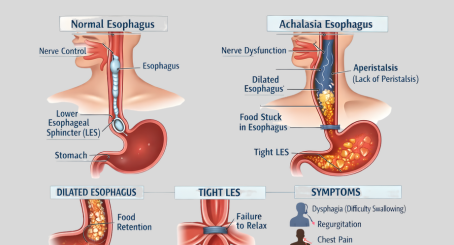
The oesophagus normally moves food toward the stomach through coordinated, wave-like muscle contractions, and the lower oesophageal sphincter (LES) — the ring of muscle at the junction of the oesophagus and stomach — relaxes briefly to let food pass through. Achalasia occurs when the nerve cells that control this coordination are damaged. As a result, the oesophagus loses its normal contractions and the LES fails to relax properly during swallowing.
Over time, food and liquid collect above the poorly relaxing LES instead of passing into the stomach. The oesophagus gradually stretches and weakens, which is why symptoms tend to be progressive rather than constant from the start. Achalasia is considered an oesophageal motility disorder, and it is a distinct diagnosis from more common motility problems and from acid reflux, even though some symptoms can overlap.
Achalasia Symptoms
The hallmark symptom is progressive difficulty swallowing both solids and liquids, but symptoms can vary between patients. Common symptoms include:
Difficulty Swallowing (Dysphagia)
Typically progressive, affecting solid foods first and later liquids as the condition becomes more advanced.
Regurgitation of Undigested Food
Undigested food or liquid may come back into the mouth, often becoming worse when lying down or during sleep.
Chest Pain
Chest pain or a sensation of food getting stuck behind the breastbone may occur after swallowing.
Unintentional Weight Loss
Weight loss may occur because of reduced food intake and discomfort or difficulty while eating.
Heartburn-Like Symptoms
Heartburn-like symptoms may occur and often do not improve with standard acid-reflux medication.
Chronic Cough
Persistent cough or repeated chest infections may result from aspiration of retained food or liquid into the airways.
Causes and Risk Factors of Achalasia
Achalasia develops when the nerves that control the muscles of the esophagus become damaged, preventing the lower esophageal sphincter (LES) from relaxing properly during swallowing. Although the exact cause is not always known, several factors may contribute to the development of this rare swallowing disorder.
- Damage to the nerves controlling the esophagus
- Failure of the lower esophageal sphincter (LES) to relax
- Loss of normal esophageal muscle contractions
- Possible autoimmune response affecting nerve cells
- Genetic factors in a small number of patients
- Rare viral infections linked to nerve damage
- Progressive widening and weakening of the esophagus
- Delayed diagnosis leading to worsening symptoms
How Is Achalasia Diagnosed?
Diagnosis typically involves a combination of the following tests, often performed in sequence:
-
Esophageal Manometry
Considered the gold-standard test; a thin catheter measures pressure and coordination of esophageal muscle contractions and confirms whether the LES relaxes normally.
-
Barium Swallow X-ray
Shows the characteristic "bird-beak" narrowing at the lower esophagus and helps assess esophageal widening.
-
Upper GI Endoscopy
Used to directly view the esophagus and rule out other causes of dysphagia, such as strictures or tumours.

What Causes Achalasia?
The exact cause of achalasia is not fully understood. Most cases are believed to result from the gradual loss of nerve cells in the wall of the esophagus, which prevents the lower esophageal sphincter (LES) from relaxing normally during swallowing. Unlike acid reflux, achalasia is not caused by diet or lifestyle habits.
- Gradual loss of nerve cells in the esophagus
- Possible autoimmune response damaging nerves
- Previous viral infection may be a trigger
- Genetic predisposition in some individuals
- Impaired relaxation of the lower esophageal sphincter (LES)
- Loss of normal esophageal muscle contractions
- Not caused by diet or unhealthy lifestyle
- Exact cause remains unknown in most patients
What Are the Treatment Options for Achalasia?
Although achalasia cannot be cured, its symptoms can be effectively managed with advanced treatments. The most appropriate option is selected based on your age, esophageal anatomy, overall health, and diagnostic findings.
Pneumatic Balloon Dilation
A minimally invasive procedure in which a balloon is inflated to widen the lower esophageal sphincter (LES), allowing food to pass more easily. Repeat sessions may be required in some patients.
POEM (Peroral Endoscopic Myotomy)
An advanced incision-free endoscopic procedure that cuts the tight muscle fibres of the LES from inside the esophagus, providing long-lasting relief from swallowing difficulties.
Laparoscopic Heller Myotomy
A minimally invasive keyhole surgery that divides the tight LES muscle. It is often combined with an anti-reflux procedure to reduce the risk of acid reflux after surgery.
Botulinum Toxin (Botox) Injection
Botox is injected into the LES to temporarily relax the muscle and improve swallowing. It is generally recommended for patients who are not suitable candidates for surgery or endoscopic treatment.
Which Achalasia Treatment Is Right for You?
POEM and Laparoscopic Heller Myotomy generally provide more durable symptom relief than balloon dilation or Botox injections. However, the most suitable treatment depends on your esophageal anatomy, previous treatments, overall health, and the results of esophageal manometry and upper GI endoscopy. A gastroenterologist will recommend the best approach after a comprehensive evaluation.
Frequently Asked Questions
Find answers to common questions about achalasia, its diagnosis, treatment options, procedures, and when to seek specialist care.
There is no single “best” treatment that suits every patient. The right option depends on your oesophageal anatomy, severity of the motility problem, overall fitness for a procedure, and findings from manometry and endoscopy. POEM and laparoscopic Heller myotomy generally offer more durable relief, while pneumatic dilation and Botox may be considered in specific situations.
No. GERD involves excess acid flowing upward into the oesophagus, while achalasia involves the oesophagus failing to move food downward because the lower oesophageal sphincter does not relax properly. The two can share symptoms such as chest discomfort or heartburn-like sensations but require different tests and treatments.
Mild cases may initially be managed with pneumatic dilation or, in select patients, Botox injections. However, many patients eventually need POEM or Heller myotomy for lasting relief, since achalasia tends to progress gradually over time.
POEM is a well-established endoscopic procedure performed under general anaesthesia, generally with a short recovery time compared with open surgery. Individual suitability should always be assessed by a gastroenterologist based on your specific anatomy and overall health.
Consider a consultation if you have progressive difficulty swallowing solids or liquids, regurgitation that persists for more than a few weeks, unexplained weight loss, or heartburn-like symptoms that are not responding to standard acid-reflux medication.
Oesophageal manometry is considered the gold-standard test for achalasia. A thin catheter measures the pressure and coordination of the oesophageal muscles and confirms whether the lower oesophageal sphincter relaxes normally during swallowing. This helps distinguish achalasia from other causes of dysphagia.
Yes. Long-standing, untreated achalasia can lead to progressive widening of the oesophagus, aspiration and chest infections, malnutrition, and a small increase in long-term oesophageal cancer risk. These complications are uncommon with timely diagnosis and appropriate treatment.
Both procedures cut the tight lower oesophageal sphincter muscle to relieve swallowing difficulty. POEM is performed entirely through the mouth without external incisions, while Heller myotomy is a keyhole laparoscopic surgery performed through small abdominal incisions. Heller myotomy is often combined with an anti-reflux procedure during the same operation.
Look for a gastroenterologist with verified credentials, access to oesophageal manometry and endoscopy, and specific experience treating achalasia with procedures such as POEM. Checking independent listings alongside the clinic’s own website can also help verify credentials and clinical experience.
Medical Disclaimer: This content is for general informational purposes only and does not replace professional medical advice, diagnosis, or treatment. Only a qualified gastroenterologist can provide an individual diagnosis and treatment plan after clinical evaluation.