
What Is Capsule Endoscopy?
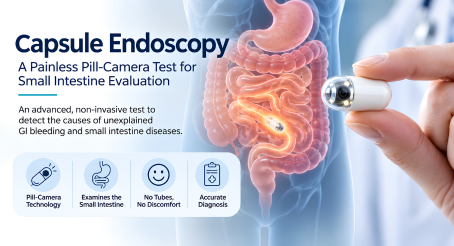
The small intestine is over 20 feet long and lies beyond the reach of both upper endoscopy and colonoscopy. Small bowel capsule endoscopy in Delhi closes this gap: the patient swallows a capsule that travels naturally through the esophagus, stomach, small intestine, and colon, capturing thousands of images along the way and transmitting them wirelessly to a recorder worn on a belt.
Because there is no scope insertion, sedation, or incision involved, it is considered one of the least invasive ways to visualize the small bowel, distinct from a diagnostic colonoscopy which examines the large intestine.
Common Reasons Capsule Endoscopy Is Recommended
Doctors typically recommend this test after other investigations haven't identified the cause of symptoms:
Capsule Endoscopy for GI Bleeding in Delhi
Used to locate the source of obscure gastrointestinal bleeding or unexplained iron-deficiency anemia when upper endoscopy and colonoscopy are normal.
Suspected Crohn's Disease
Detecting inflammation, ulcers, or narrowing in the small intestine.
Small Bowel Tumors or Polyps
Identifying abnormal growths, especially in higher-risk patients.
Chronic Abdominal Pain or Diarrhea
Evaluating persistent symptoms when blood tests and imaging haven't found a cause.
Celiac Disease Evaluation
Assessing the extent of small bowel damage in confirmed or suspected cases.
Follow-up After Abnormal Imaging
Confirming and further evaluating findings from a CT scan or MRI.
Benefits of Capsule Endoscopy at a Glance
Patients researching painless endoscopy in Delhi are usually comparing comfort and recovery time across procedures. Capsule endoscopy offers:
- Completely non-invasive — no scope, incisions, or needles involved
- Painless, with no sedation or anesthesia needed
- Visualizes the entire small intestine, an area other scopes struggle to reach
- Patients can continue most normal daily activities during the test
- No recovery time or hospital stay required
- Capsule passes naturally and does not need retrieval
- Often used as a first-line test before deciding whether DBE or further treatment is needed
How Wireless Capsule Endoscopy Works
Wireless capsule endoscopy in Delhi generally follows a predictable sequence, from preparation to image review:
Preparation
Fasting for about 12 hours beforehand, similar to preparing for a standard endoscopy, with clear liquids the evening before.
Swallowing the Capsule
Taken with a glass of water at the clinic; no sedation or anesthesia is required.
Wearing the Recorder
A small device worn on a belt for 8 to 12 hours while the capsule travels through the digestive tract, wirelessly capturing images.
Going About Your Day
Most patients return to work and normal activities during the recording period, though strenuous exercise and MRI machines are avoided until the capsule has passed.
Capsule Passage
The disposable capsule passes naturally in a bowel movement within 24 to 48 hours; no retrieval is needed.
Image Review
The recorder is returned to the clinic, and the doctor reviews the thousands of captured images for abnormalities.
Capsule Endoscopy vs. Double Balloon Enteroscopy vs. Traditional Endoscopy
Each procedure serves a different purpose in evaluating the digestive tract; the gastroenterologist recommends the most appropriate option based on the patient's condition and whether biopsy or treatment is likely to be needed.
| Feature | Capsule Endoscopy | Double Balloon Enteroscopy (DBE) | Traditional Endoscopy |
|---|---|---|---|
| Invasiveness | Non-invasive (swallowed capsule) | Scope inserted | Scope inserted |
| Sedation | Not required | Required | Mild sedation |
| Area Visualized | Entire small intestine | Targeted small intestine | Esophagus, stomach & duodenum |
| Biopsy Possible? | No | Yes | Yes |
| Procedure Time | 8–12 hrs | 30 min – few hrs | 15–30 min |
| Best For | Initial small bowel screening | Treatment & biopsy | Upper GI problems |
Capsule Endoscopy in South Delhi
For residents of South Delhi, having capsule endoscopy in South Delhi available close to home matters, since the recording period lasts 8 to 12 hours and typically involves an initial fitting visit followed by a return visit to drop off the recorder. A clinic that is not a long drive away makes both visits considerably easier to manage.
Patients searching for a capsule endoscopy specialist in South Delhi are usually looking for the same combination of things: a clear explanation of whether their symptoms warrant small bowel evaluation, prompt scheduling, and — if the capsule finds an abnormality that needs treatment or biopsy — access to follow-up procedures such as double balloon enteroscopy under the same specialist.
Delhi Gastro Care is based at Fortis Escorts Liver and Digestive Disease Institute, Okhla Road, and is accessible to patients across South Delhi neighbourhoods such as Okhla, Kalkaji, Nehru Place, Greater Kailash, Sarita Vihar, Jasola, and New Friends Colony.
Choosing a Capsule Endoscopy Specialist in Delhi
Because an abnormal capsule finding often needs a follow-up decision — repeat imaging, medication, or a therapeutic procedure such as DBE — choosing a capsule endoscopy specialist in Delhi who can manage the full pathway, not just the initial screening, makes a meaningful difference to outcomes. The best doctor for capsule endoscopy in Delhi will interpret findings in the context of your full symptom history rather than issuing a standalone image report. A few things worth checking before your first visit:
- Verified medical qualification and registration in gastroenterology
- On-site or nearby access to double balloon enteroscopy for follow-up treatment or biopsy
- A clear explanation of what the capsule can and cannot detect compared with other procedures
- Experience managing obscure GI bleeding, Crohn's disease, and celiac disease
- Transparent guidance on preparation, timing, and when to expect results
At Delhi Gastro Care, Dr. (Brig) Pankaj Puri — a gastroenterologist for capsule endoscopy in Delhi practising at Fortis Escorts, Okhla — holds DM Gastroenterology training from PGIMER, Chandigarh, and FRCP qualifications from Edinburgh and London. He is the Director of Gastroenterology and Hepatology at the Fortis Escorts Liver and Digestive Diseases Institute and offers a comprehensive small bowel work-up, from initial capsule screening through to therapeutic double balloon enteroscopy, under one specialist.
Frequently Asked Questions
Find answers to common questions about Capsule Endoscopy, including why it's recommended, how it works, and what to expect afterward.
Capsule endoscopy is a non-invasive procedure in which a patient swallows a small, pill-sized camera that travels naturally through the digestive tract, capturing thousands of images of the small intestine — an area difficult to reach with traditional endoscopy or colonoscopy.
It is commonly used to investigate unexplained gastrointestinal bleeding, unexplained anemia, suspected Crohn's disease, small bowel tumors or polyps, and chronic abdominal pain or diarrhea when other tests haven't identified a cause.
No. The procedure is completely painless and does not require sedation. The capsule is swallowed like a large pill, and most patients feel nothing as it moves through the digestive tract.
The capsule typically takes 8 to 12 hours to pass through the digestive tract while recording images, though patients can go about most normal daily activities during this time. The initial appointment to swallow the capsule and attach the recording device takes about 30 minutes.
No. The capsule is disposable and passes naturally in a bowel movement within 24 to 48 hours. The recording device is returned to the clinic, and the doctor reviews the images to check for abnormalities.
No. Capsule endoscopy can only capture images; it cannot take a tissue sample. If a biopsy is needed, your gastroenterologist may recommend a follow-up procedure such as double balloon enteroscopy.
Look for a gastroenterologist with verified credentials, on-site or nearby access to follow-up procedures such as double balloon enteroscopy, and a track record of interpreting capsule findings within the context of your full symptom history rather than a standalone report.